

Battery management
boards, built for the pack
you are actually building.
Genuine Daly protection boards for Li-ion and LiFePO4 packs — 3S to 13S, 15 A to 100 A, common port, passive balancing. The board cuts the pack off before a single cell leaves its safe window, so the whole pack ages together instead of one cell taking the damage.
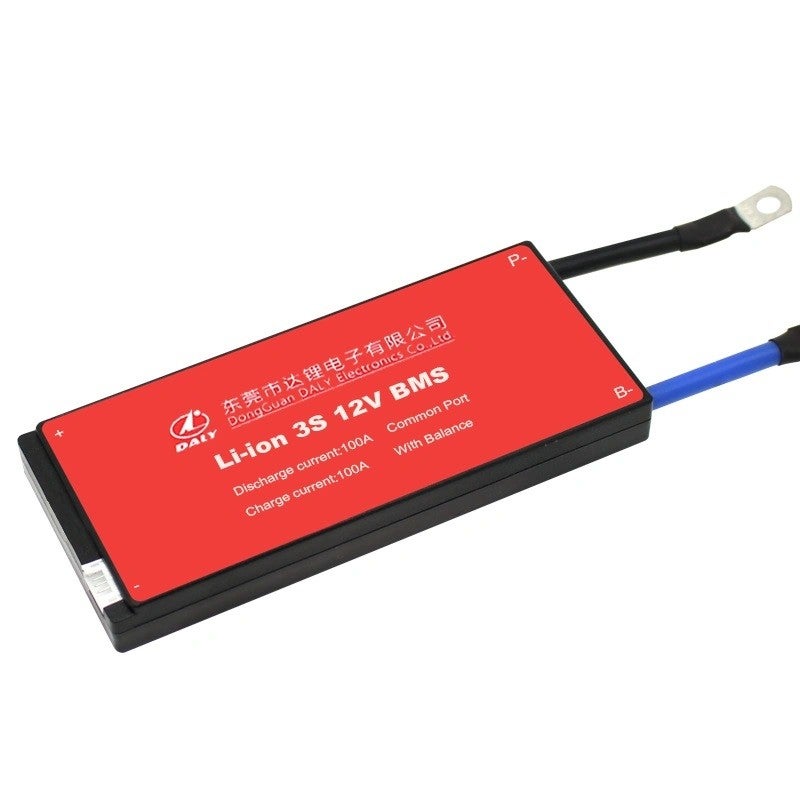
Common Port · With Balance
We do not make these boards — Daly does. We buy them, keep them on the shelf and sell them on, and we will tell you which one fits before you order.
Send us the chemistry, the cells in series and the current and we will tell you which board fits — we would rather lose the sale than ship the wrong one.
Li-ion and LiFePO4, 12 V to 48 V, 15 A to 100 A — every board listed with its cell count, its current and its price. Nothing behind an enquiry form.
Over-charge, over-discharge, over-current, short circuit, temperature, ESD, flame-retardant potting and a water-resistant glue fill.
Three answers and you have the right board
A BMS has to match the chemistry, the number of cells in series and the current your load actually pulls. Get the chemistry wrong and the board charges the cells past their limit; get the current wrong and it trips the moment you put the throttle down.
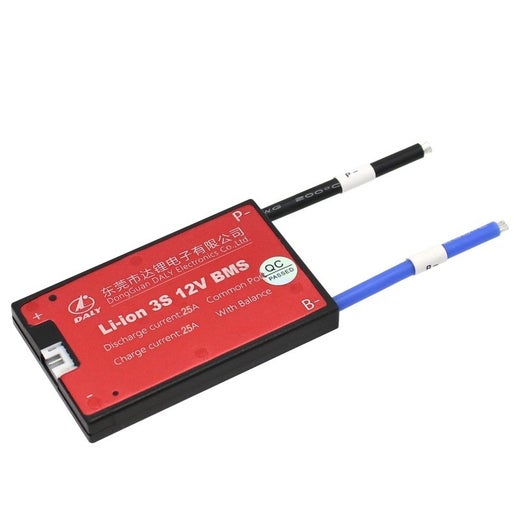
Li-ion 3S 12 V · 30–40 A
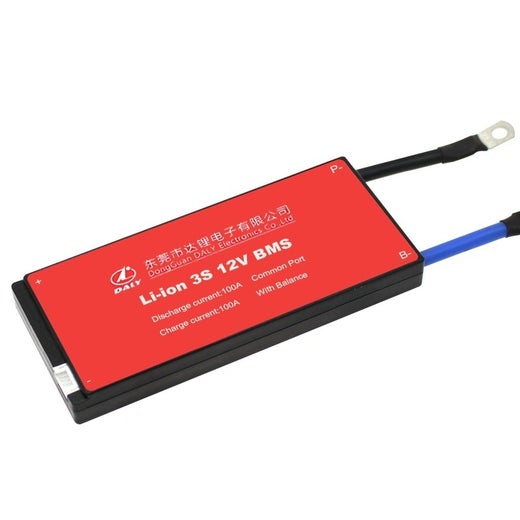
Li-ion 3S 12 V · 100 A
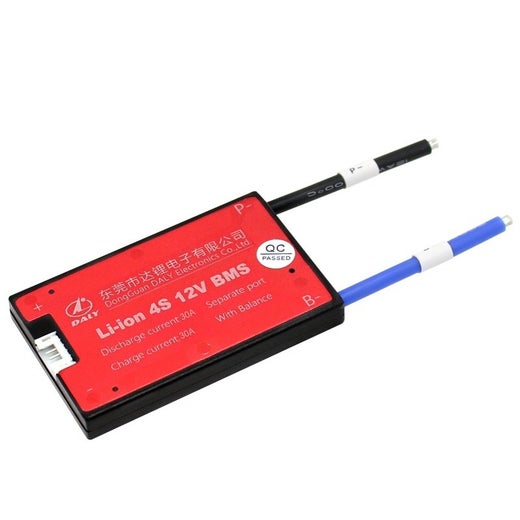
4S 12 V · 30–40 A
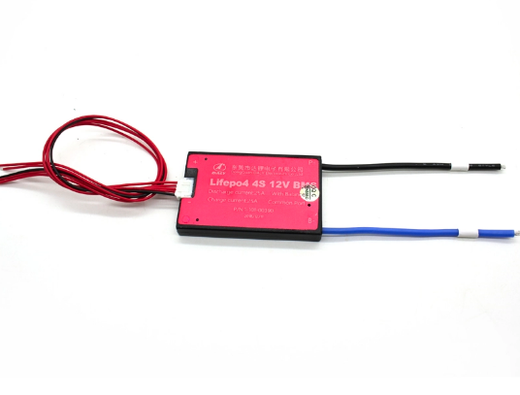
LiFePO4 4S 12 V · 30–40 A
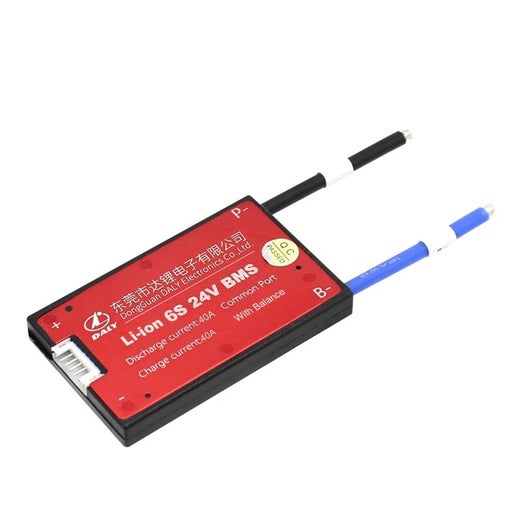
Li-ion 6S 24 V · 15 A
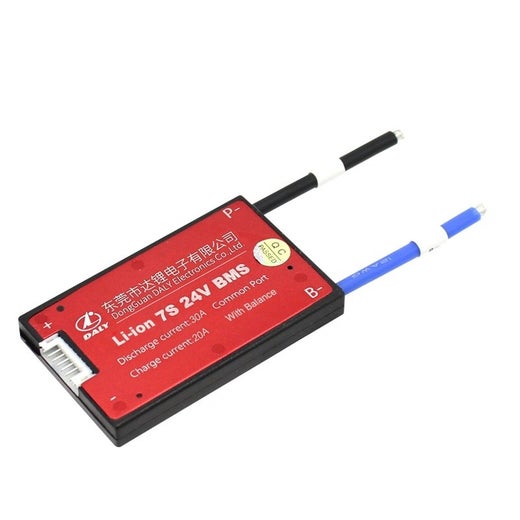
Li-ion 7S 24 V · 30–40 A
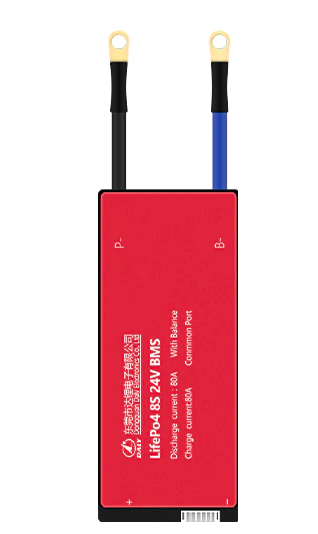
LiFePO4 8S 24 V · 80 A
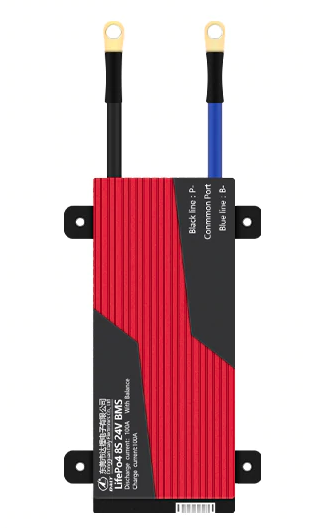
LiFePO4 8S 24 V · 100 A
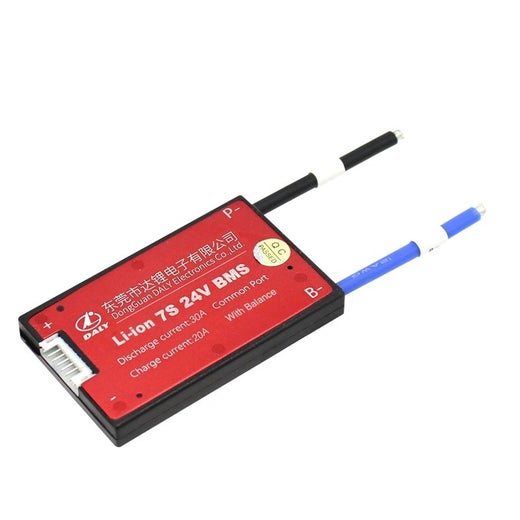
Li-ion 10S 36 V · 15 A
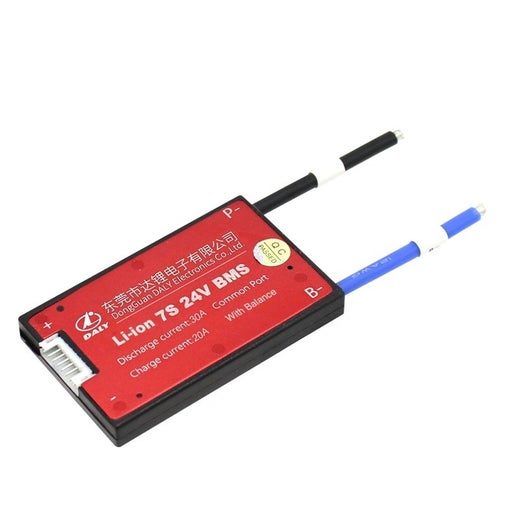
Li-ion 10S 36 V · 20–60 A
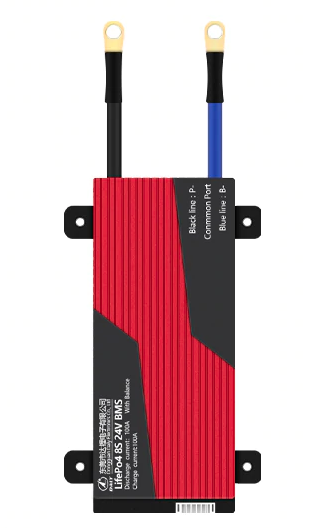
LiFePO4 12S 36 V · 30–60 A
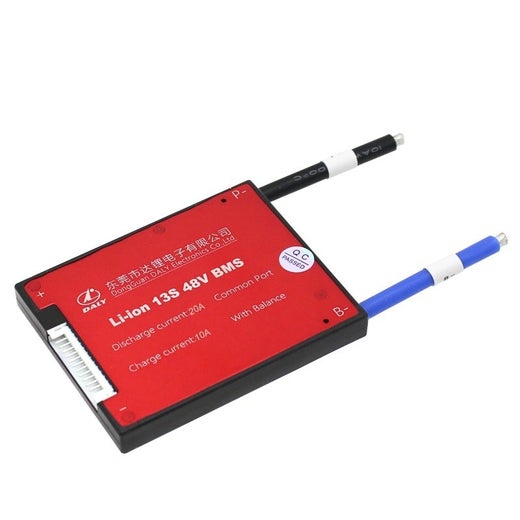
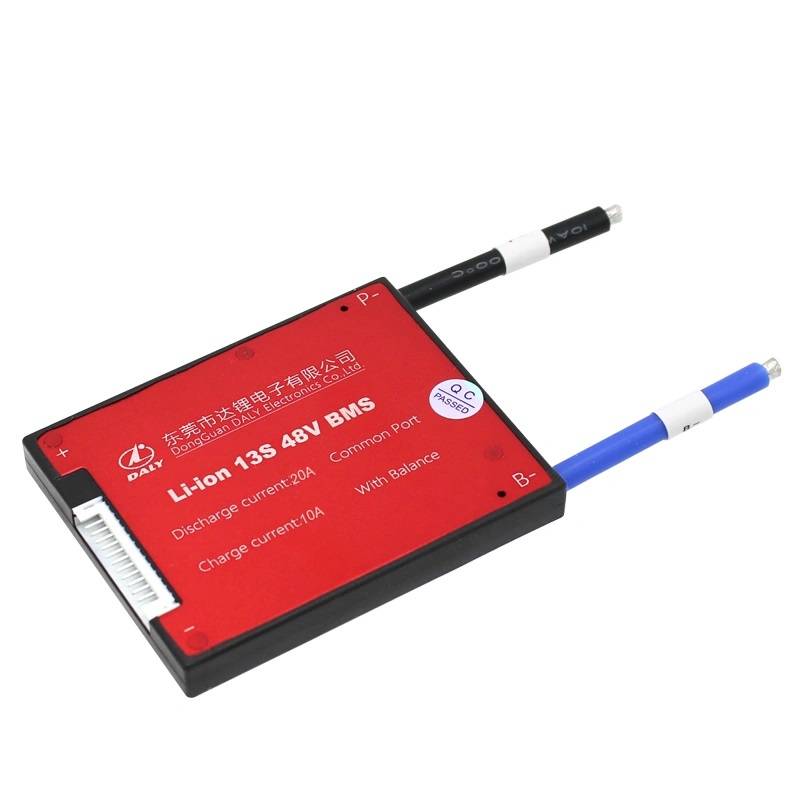
Li-ion 13S 48 V · 30–60 A
The Daly range runs from 3S to 24S and up to 400 A, and we can order most of it in even when it is not on the shelf. Loosen a filter, or look at the wider range below.
See the full Daly programmeCells in series, and what the pack really measures
A "12 V" lithium pack is almost never 12.0 V. Count the cells in series, multiply by the cell voltage, and order the board for the cell count — never for the badge on the label.
Li-ion / Li-po
3.7 V nominal · 4.2 V full · 2.75 V cut-off| Cells | Nominal | Full charge | Sold as | In stock |
|---|---|---|---|---|
| 3S | 11.1 V | 12.6 V | 12 V | 30–100 A |
| 4S | 14.8 V | 16.8 V | 12 V | 30–40 A |
| 6S | 22.2 V | 25.2 V | 24 V | 15 A |
| 7S | 25.9 V | 29.4 V | 24 V | 30–40 A |
| 10S | 37.0 V | 42.0 V | 36 V | 15–60 A |
| 13S | 48.1 V | 54.6 V | 48 V | 30–60 A |
| 14S | 51.8 V | 58.8 V | 48 V | on request |
| 16S | 59.2 V | 67.2 V | 60 V | on request |
| 20S | 74.0 V | 84.0 V | 72 V | on request |
LiFePO4
3.2 V nominal · 3.65 V full · 2.5 V cut-off| Cells | Nominal | Full charge | Sold as | In stock |
|---|---|---|---|---|
| 4S | 12.8 V | 14.6 V | 12 V | 30–40 A |
| 8S | 25.6 V | 29.2 V | 24 V | 80–100 A |
| 12S | 38.4 V | 43.8 V | 36 V | 30–60 A |
| 15S | 48.0 V | 54.8 V | 48 V | on request |
| 16S | 51.2 V | 58.4 V | 48 V | on request |
| 20S | 64.0 V | 73.0 V | 60 V | on request |
| 24S | 76.8 V | 87.6 V | 72 V | on request |
Never swap the chemistry. A Li-ion board stops charging at 4.2 V per cell. Put it on a LiFePO4 pack and it will push every cell 0.55 V past its limit, every single charge.
Common port or separate port
This is the one choice people get wrong. It decides how many power wires leave the board and whether the charger and the load can share a single connector.
Common port
Recommended- 2Two power wires leave the board: B− to the pack, P− shared by the charger and the load.
- ✓Charger and load plug into the same connector — a scooter, a power bank, a portable pack.
- ✓Charge current is not throttled by a separate charge MOSFET path.
- ✓A common-port board can be wired in place of a separate-port board. The reverse is not true.
Every board on this page except one is common port.
Separate port
Specific builds- 3Three power wires: B−, C− for the charger and P− for the load, on their own connectors.
- !Daly's separate-port boards are built with a charge current of 8 A by default — fine for an overnight charger, not for fast charging.
- !A separate-port board cannot be rewired as a common-port board.
- ✓Use it when the pack already has a dedicated charge socket that must stay live while the load is switched off.
Available on the LiFePO4 8S 24 V 100 A board.
Eight ways it stops the pack from destroying itself
A lithium pack has no self-preservation. Every one of these protections is on every board in the shop — there is no "basic" version that leaves one out.
Cuts the charge path the moment any single cell hits its upper limit — not when the pack average does.
Disconnects the load before the weakest cell is dragged below its cut-off and permanently loses capacity.
Trips when the draw exceeds the board's rating, then recovers once the load is removed.
Hardware latch — microseconds, not milliseconds. This is the protection that keeps a dropped spanner from starting a fire.
NTC sensing on the pack. Charging a cold lithium cell plates metallic lithium — the board refuses.
ESD protection on the sense lines, where a technician's fingers meet the balance connector.
Flame-retardant materials throughout the assembly, so a fault does not become a fuel source.
Daly's patented glue-injection process fills the housing — moisture and vibration both stay out.
The "with balance" versions bleed the highest cells through a resistor at the top of charge, so the pack tops out level instead of one cell running away. Need faster correction on a tired pack? Daly's separate active balancers move charge between cells at 1 A, 5 A or 10 A.
The high-current boards sit in a finned anodised shell that pulls heat straight off the MOSFETs. That is why a 100 A board is a slab of metal and a 15 A board is a potted brick.
Pre-set screw mounting holes and a keyed buckle-type balance connector, so the lead only goes in one way round — the mistake that kills more boards than anything else.
Beyond the boards on the shelf
The boards above are Daly's standard hardware BMS. The wider Daly range runs from 3S to 24S and up to 400 A and adds Bluetooth, RS485, CAN and cloud monitoring. We do not stock all of it, but we can order anything in these categories in for you.
H, K, M and S series — 3S to 24S, 40 A to 200 A. UART, RS485 and CAN, the Daly Bluetooth app and Daly Cloud, plus protocol matching for mainstream inverters.
EXPLORE →G series 15–20 A, H series 40–60 A, K series 40–100 A, M series 150–200 A. Hardware protection and passive balancing, no communication port.
EXPLORE →Finned aluminium boards for packs that pull serious current — forklifts, AGVs, marine drives and off-grid inverters.
EXPLORE →Protection and active balancing in one board: charge is moved from the strong cells into the weak ones instead of being burnt off as heat.
EXPLORE →For home and RV storage packs: parallel pack support, WiFi, Bluetooth and 4G, and inverter protocol docking.
EXPLORE →Built for cranking current — a starter motor asks for hundreds of amps for a second or two, which is a different problem from steady discharge.
EXPLORE →Stand-alone modules at 1 A, 5 A and 10 A for 3S to 24S. They work alongside whatever BMS is already in the pack.
EXPLORE →Daly chargers at 500 W, 1000 W and 1500 W — the 1000 W smart charger is IP67, 10–30 A, Bluetooth with OTA and BMS linkage.
EXPLORE →An independent reseller, not the factory
DALYELEC.EU is an independent reseller of Daly battery management boards. We are not the manufacturer and we are not Daly's own web shop — Daly designs and builds the hardware, and we buy it, stock it and sell it on.
The shop is operated by JRSE Ltd., a distributor of electronic components and test & measurement equipment for the electronics industry. Orders are dispatched from Hong Kong and priced in euros. Where import taxes or customs charges apply, our terms and conditions set out how they are handled.
The questions that come in every week
What does a BMS actually do?
It watches every cell in the series string individually. It cuts the charge path when any one cell reaches its upper voltage limit, cuts the discharge path when any one cell reaches its lower limit, trips on over-current and short circuit, and stops charging outside the safe temperature window. On the "with balance" versions it also bleeds the highest cells at the top of charge, so the pack stays level over its life instead of drifting apart.
Common port or separate port — which do I need?
Common port has two power wires and one shared negative terminal, so the charger and the load use the same connector. Separate port has three, with a dedicated C− for the charger. If your pack has one socket that you both charge and discharge through, you want common port. A common-port board can replace a separate-port board; the reverse cannot be done. When in doubt, choose common port. See the wiring diagrams above.
Do I need the "with balance" version?
Almost always, yes. Cells are never perfectly matched, and without balancing the strongest cell hits the upper limit first and stops the charge for the whole pack — so you slowly lose usable capacity. Passive balancing bleeds the leading cells off through a resistor until the string evens out. The only reason to buy a board without balance is if you already have a dedicated external balancer in the pack.
Can I put a Li-ion board on a LiFePO4 pack?
No. The cut-off voltages are set in hardware for one chemistry. A Li-ion board lets a cell run to 4.2 V; a LiFePO4 cell must stop at 3.65 V. Fitting the wrong board over-charges every cell on every cycle. Match the chemistry first, then the cell count, then the current.
How many amps should I order?
Size the board for the peak continuous current your load draws, not the average, and leave headroom above it. A motor that averages 25 A but pulls 45 A up a hill will keep tripping a 30 A board. The current rating also sets the physical build — the higher ratings come in a finned aluminium shell because the MOSFETs need somewhere to put the heat.
Do these boards have Bluetooth or an app?
The boards listed here are standard hardware BMS — all the protection, no communication port. Daly's Smart BMS range adds UART, RS485 and CAN, the Daly Bluetooth app with adjustable protection thresholds, and Daly Cloud for remote monitoring and firmware updates. Those are available to order.
Which cell count do I need for a 48 V system?
With Li-ion cells it is 13S (48.1 V nominal, 54.6 V full) or 14S (51.8 V nominal, 58.8 V full). With LiFePO4 it is 15S or 16S (51.2 V nominal, 58.4 V full). Count the cells in your pack rather than trusting the "48 V" on the label — the reference tables above give every step.
Are these genuine Daly boards, and where do they ship from?
Yes, they are genuine Daly boards. To be clear about who we are: DALYELEC.EU is an independent reseller, not the manufacturer and not Daly's own shop. The shop is operated by JRSE Ltd. and orders are dispatched from Hong Kong. Where import taxes or customs charges apply, they are covered in the terms and conditions page.
Twelve boards on the shelf. From €14.
Li-ion and LiFePO4, 3S to 13S, 15 A to 100 A, common port with passive balancing, each one listed with its cell count and its current.